Thanklessly Maintaining Open Source Software: the book
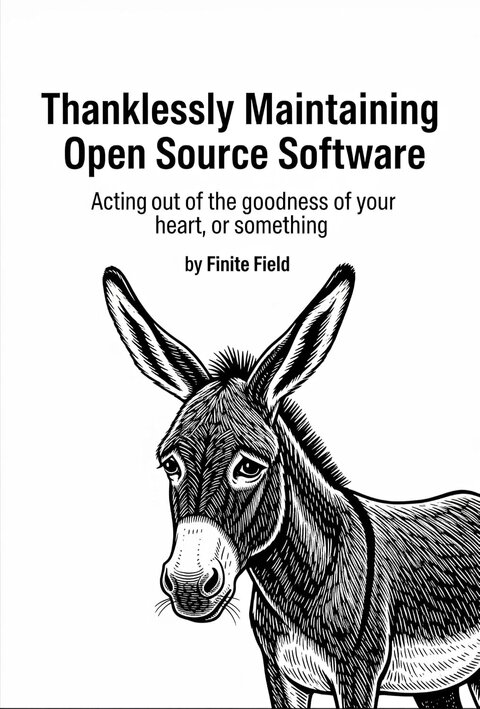
Thanklessly Maintaining Open Source Software started as a fake O’Reilly book cover, and it is now an actual book on Amazon. It has 95 pages, a year in the life of one unlucky maintainer, and a price of exactly one hexadecimal dollar. This post explains what is in it, and why you might want it anyway.
The joke
You have probably seen the cover before. For a while, the internet made parody O’Reilly covers: an animal engraving, a bold title, and a subtitle that says the quiet part out loud. One of them, by @ThePracticalDev, was titled Thanklessly Maintaining Open Source Software, with the subtitle Acting out of the goodness of your heart, or something. Anyone who has maintained a project that other people depend on laughed at it, and then felt a bit uneasy.
A joke cover has no pages behind it. I wanted to know what the pages would say.
How the joke grew into a book
I gave the cover to Google’s Gemini as a prompt, and asked for the book.
Then I kept asking, chapter by chapter, until the model had nothing more to
say on the subject.
I assembled the text with bazel-ebook, the same build
rules I use for my other books, and published it on Kindle.
The book says this about itself on the first page. The disclaimer states that the story is fiction, and that the text is from Gemini. The author name on the cover is Finite Field, which is a joke for the mathematicians in the audience.
So this is probably an overgrown joke. It is a joke that became 95 pages long, has a table of contents, and went through a publishing pipeline. I still found it entertaining to read, and in places it is uncomfortably accurate.
What is in it
The book follows one developer through a single year with
config-o-matic, a small Go library they wrote for themselves.
It starts with the first commit and ends with the archive button.
The book addresses the maintainer as “you”, so the reader gets to live
through it.
There are four parts:
- The Honeymoon Phase. The first commit, choosing a license, the first star, and the first pull request from a stranger. Everything is still exciting.
- The Grind. Issue #1, titled “It Doesn’t Work”. Vague bug reports, feature requests that would triple the scope, and dependency updates as an unpaid part-time job.
- Advanced Thanklessness. A corporate user who files a critical issue at 4:30 PM on a Friday and needs it fixed by Monday. A CVE with your name on it. Monetization, from “Buy Me a Coffee” upwards.
- The Burnout Vector. Stale pull requests, a fork that becomes more popular than the original, a social media dogpile, and finally archiving the repository.
There is also a foreword, written in the voice of the maintainer of left-pad: eleven lines of JavaScript that broke a large part of the internet when they were unpublished.
The appendices are the useful part
Appendix A is a list of canned responses for unreasonable demands. Each entry shows what the user wrote, what you want to write, and what you should write instead. For an issue that says only “Your code is broken. Pls fix.”, the reply you want to send is:
What doesn’t work? The concept of object permanence? Your shift key? My will to live?
The reply the book recommends is a polite request for the library version, the runtime version, a minimal reproducible example, and the full error message. You can copy that one into your issue templates today.
Appendix B is a field guide to recognizing burnout. Appendix C asks whether you want to do it all over again. Most maintainers do, and that is the joke at the center of the book.
The price
The Kindle edition costs $2.56.
That is 256 cents, or 0x100 cents in hexadecimal.
If a dollar had 0x100 cents, the book would cost exactly one dollar.
I think this makes it the ideal purchase for anyone who counts in powers of
two.
It would be nice if I could earn about fleventy dollars from it.
In hexadecimal, fleventy is 0xF0, which is 240 in decimal.
For comparison, it costs less than the coffee that most open source maintainers never receive from their users.
Who it is for
- Maintainers, who will recognize every chapter.
- People who use open source at work, and want to know what the other side of the issue tracker looks like.
- Anyone who laughed at the original cover and wondered what was inside.
The book is on Amazon: Thanklessly Maintaining Open Source Software.
If you read it and liked it, a review on Amazon helps. If you read it and did not like it, you now know how a maintainer feels on a Sunday morning.